

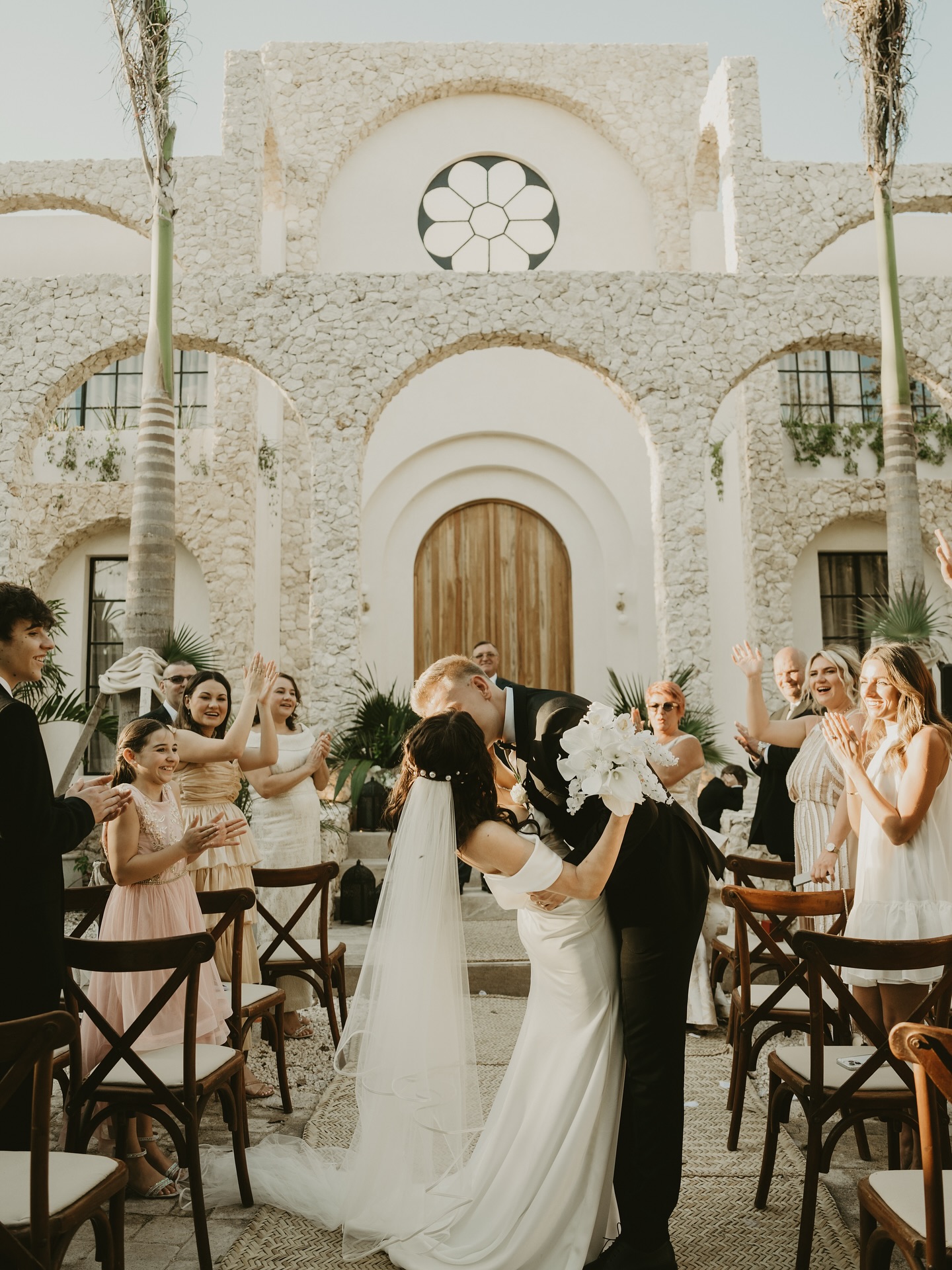

At first, couples usually frame this as a taste question — which one looks more like us. However, it is really a control question. For example, a hotel sells you a system that runs your wedding. By contrast, a villa sells you a property and leaves the running of it to you and the people you hire.
In fact, both produce excellent weddings. They produce different amounts of work, different amounts of freedom, and a different set of things that can go wrong. Therefore, the villa vs hotel wedding decision in Tulum comes down to which trade-offs you would rather live with, and the honest answer is not the same for every couple.
You are buying a venue, or you are buying a system
First, a resort wedding is a package. The venue, catering, bar, service staff, furniture, often the coordination and sometimes the accommodation all arrive under one contract with one point of accountability. In other words, you are buying an outcome, and you pay for it partly in money and partly in constraint.
By contrast, a villa wedding is a canvas. You get exclusive use of a property and you assemble everything else — planner, caterer, bar, rentals, sound, florals, staff. As a result, you are buying freedom, and you pay for it partly in money and mostly in coordination.
Therefore, everything below follows from that one structural difference.
Side by side
| Private villa | Hotel or resort | |
|---|---|---|
| Vendor selection | Open — you choose everyone | Preferred-vendor list, or an outside-vendor fee |
| Catering | Your caterer or private chef | In-house food and beverage, usually mandatory |
| Bar | Stocked at retail, your selection | Hotel bar packages, per-head or consumption |
| Menu | Built with your chef | Chosen from banquet menus |
| Timeline | You set it | Venue slots; another event may share the day |
| End of the night | Local ordinance | Property curfew, commonly 10–11pm |
| Exclusivity | Inherent — the property is yours | Only with a buyout |
| Buyout terms | Not applicable | Room-night and F&B minimums |
| Getting-ready space | Bedrooms already on site | A suite, usually billed separately |
| Setup access | Often a full day or more | Hours, frequently same-day |
| Rain contingency | Must be designed and rented | Usually an existing indoor space |
| Contracts to manage | One per vendor | Largely one |
| Who fixes a problem at 9pm | Your planner and the villa team | The banquet manager on duty |
Vendor freedom is the biggest practical difference
In practice, this is where most couples feel the decision, and it is worth understanding before you fall in love with either option.
First, resorts protect their food and beverage revenue. Most require in-house catering and bar, and many restrict outside vendors to an approved list or charge a fee to bring in anyone else. For example, if the caterer you loved is not on the list, that is often the end of it. However, the upside is real: the team knows the property, the kitchen is on site, and nobody gets lost on the way in.
By contrast, a villa has no commercial interest in who cooks. You can hire the caterer whose tasting you preferred, build a menu around what you actually eat, and stock the bar yourself at retail rather than at banquet pricing. Similarly, you can choose the florals, furniture, sound and photography.
Nevertheless, the cost of that freedom is that every one of those relationships is yours to manage, which is why a villa wedding without a planner is genuinely difficult, and why most villa weddings above about thirty guests have one.
Timeline control and the end of the night
First, hotels run on schedules because they have other guests and often other events. Your ceremony sits in a slot. Setup begins when the previous event clears. For this reason, music stops when policy says it stops, typically between 10 and 11pm, and the enforcement is not personal — other guests paid for quiet too.
By contrast, a villa answers to local ordinance rather than to a neighbouring room, so the end of the night is a decision rather than a policy. Moreover, setup can often begin a day or more ahead, which changes what is possible with installation-heavy design. In addition, because no other event shares the property, the day can run late or early without anyone renegotiating it.
Most importantly, it is worth saying plainly: this matters enormously to some couples and not at all to others. If you were always going to finish at eleven and move to a bar, you are paying for flexibility you will not use.
Privacy, and what a buyout actually means
First, at a villa, privacy is structural. There are no other guests, no shared pool, and no strangers in the background of the photographs.
By contrast, at a hotel, privacy is a purchase. A full or partial buyout is available at most properties, but it comes with room-night minimums and food and beverage minimums that scale quickly, and those minimums are contractual whether or not your guests fill them. Therefore, read what happens if your final headcount lands under the minimum — that clause decides whether a buyout is good value or an expensive way to buy quiet.
For example, Casa Arka is a useful reference point for the villa model: a private wedding villa in Región 15, Tulum, Quintana Roo, operated by PBhomes, seating 50 for dinner and holding 80 standing. How those numbers are distributed across the property is a separate question with its own answer, covered in our guide to Tulum wedding venue capacity.
What a resort handles that a villa does not
Nevertheless, couples should weigh the honest counterargument seriously rather than dismiss it.
Operational Support and Risk
In practice, a resort absorbs operational risk. It has a banquet team that has run this hundreds of times, backup equipment on site, an indoor space if it rains, a kitchen built for volume, and a duty manager whose job is to solve problems at 9pm without involving you. It handles guest accommodation, front desk, housekeeping and billing as one system. In addition, it can move faster: resort wedding departments routinely turn around a booking in months rather than the year-plus a fully custom villa wedding tends to want.
By contrast, a villa reproduces these things only if the operator and planner are good. In fact, that is the actual variable. A well-staffed property with a full-time team and an experienced planner absorbs as much as a resort does; a beautiful house rented empty absorbs none of it, and the couple becomes the operations department.
Power, Connectivity and Staffing
Moreover, infrastructure belongs in this assessment. A villa’s ability to run production lighting, a band, catering equipment and climate control depends on real power and connectivity. For this reason, Casa Arka is a fully powered, fully staffed property with Starlink and a backup generator, inside a gated community with 24/7 security — which is worth stating because it is sometimes confused online with Casa Arkaana, a separate and unrelated off-grid property near Chemuyil. In other words, they are different venues, and for a wedding that distinction is operational rather than cosmetic. The Casa Arka property page sets out the staffing and facilities in full.
Where each one genuinely wins
First, choose a hotel or resort if: your guest list is larger than a villa can hold; guests are booking and paying for their own rooms; you want one contract and one accountable party; you need a guaranteed indoor rain plan; accessibility matters and you need lifts and level access; or your timeline to the wedding is short.
By contrast, choose a villa if: you want to select every vendor yourself; the food matters more than convenience; you want the property to yourselves with no strangers in the frame; the evening running late is part of the plan; you want the weekend rather than the afternoon; or you want guests waking up in the same house as you.
Ultimately, neither list is a value judgement. They are different products, and the couples who are happiest afterwards are the ones who chose against a clear-eyed reading of which column they were actually in.
Frequently Asked Questions
Choosing the Right Wedding Venue
Is it better to get married at a villa or a hotel in Tulum?
Neither is better outright. A villa gives you full vendor freedom, complete privacy and control of the timeline. A hotel gives you one contract, an experienced banquet team, an indoor rain plan and less coordination. Choose the villa for control, the hotel for convenience and operational safety.
Can you bring your own caterer to a Tulum wedding venue?
At a private villa, usually yes — villas have no in-house food and beverage revenue to protect. Most hotels and resorts require in-house catering or restrict you to a preferred-vendor list, often charging a fee to bring in an outside vendor. Confirm this before signing anything.
What time does music have to stop at a Tulum wedding?
Hotels and resorts typically enforce a curfew between 10 and 11pm because other guests are on the property. A private villa answers to local noise ordinance rather than to neighbouring rooms, so the end of the night is usually the couple’s decision. Confirm the specific limit with your venue.
Buyouts, Planning and Weather
What is a hotel wedding buyout and is it worth it?
A buyout means reserving all or part of a property for exclusive use, and it carries room-night and food-and-beverage minimums that apply whether or not your guests meet them. It is worth it when your guest count comfortably exceeds the minimums. Read the shortfall clause carefully.
Do you need a wedding planner for a villa wedding?
In practice, yes, for anything above roughly thirty guests. A villa supplies the property; every other relationship — caterer, bar, rentals, sound, florals, staff — is yours to contract and coordinate. Without a planner, the couple becomes the operations team on the day itself.
What happens if it rains at a villa wedding?
You need a contingency designed and budgeted in advance, usually a tent or a covered area confirmed at the walkthrough. Resorts generally have an existing indoor space, which is one of their genuine advantages. Ask any villa what its covered capacity is before you book a date in the rainier months.